Best Boxing Gloves Manufacturer: The Complete Guide to Choosing the Right Factory in 2026
Finding the best boxing gloves manufacturer is not simply a matter of finding the lowest price or choosing the factory with the most attractive website.
For a boxing brand, gym, distributor, sports retailer, importer, or private-label business, the manufacturer you choose can determine almost everything that matters after the order is placed: glove quality, consistency, durability, comfort, customer complaints, production timelines, margins, packaging, compliance, and ultimately your reputation in the market.
There are hundreds of boxing glove suppliers around the world. Some are trading companies. Some are wholesalers. Some are small workshops. Others are established factories with dedicated production teams, quality-control systems, export experience, and OEM capabilities.
So how do you determine which one is actually the best boxing gloves manufacturer for your business?
The answer depends on what you are buying.
A manufacturer that is excellent for a large established boxing brand may not be the right choice for a startup ordering 100 pairs. A factory specializing in handmade premium leather gloves may not be the best supplier for a budget fitness retailer. A manufacturer experienced in competition equipment may not be the ideal partner for a fashion-focused private-label brand.
The real objective is to find the manufacturer whose capabilities, quality level, minimum order quantity, pricing, communication, compliance, production capacity, and customization options match your requirements.
This guide explains exactly how to do that.
Table of Contents
- What Is a Boxing Gloves Manufacturer?
- What Makes a Manufacturer the Best?
- Manufacturer vs. Supplier vs. Trading Company
- Where Are the Best Boxing Gloves Manufactured?
- Why Sialkot, Pakistan Is a Major Boxing Glove Manufacturing Hub
- How Boxing Gloves Are Manufactured
- Boxing Glove Materials
- Leather vs. Synthetic Boxing Gloves
- Understanding Boxing Glove Padding
- Glove Construction and Stitching
- Boxing Glove Weight and Size
- Different Types of Boxing Gloves
- Training Gloves
- Sparring Gloves
- Bag Gloves
- Competition Gloves
- Professional Boxing Gloves
- Muay Thai Gloves
- Custom Boxing Gloves
- OEM Boxing Gloves
- Private Label Boxing Gloves
- ODM Boxing Gloves
- Minimum Order Quantity
- Boxing Gloves Manufacturer Pricing
- What Determines the Cost of Boxing Gloves?
- A Worked Example: From Factory Price to Landed Cost
- Typical Payment Terms When Ordering from a Boxing Glove Manufacturer
- Quality Control
- Sample Development
- Certifications and Standards
- Important Compliance Considerations
- Compliance Standards Specific to Boxing Gloves: EN 13277-1 and CPSIA
- How to Audit a Boxing Glove Factory
- Questions to Ask a Manufacturer
- Red Flags When Choosing a Supplier
- How to Compare Five Manufacturers
- Best Manufacturer for Startups
- Best Manufacturer for Established Brands
- Best Manufacturer for Gyms and Academies
- Best Manufacturer for Distributors
- Best Manufacturer for Premium Boxing Gloves
- Best Country for Boxing Glove Manufacturing
- How to Order Custom Boxing Gloves
- Packaging and Branding
- International Shipping
- Lead Times
- How to Protect Your Brand
- Why Cheap Boxing Gloves Can Become Expensive
- The Ideal Manufacturer Checklist
- Frequently Asked Questions
- Final Verdict
1. What Is a Boxing Gloves Manufacturer?
A boxing gloves manufacturer is a company or factory that actually produces boxing gloves rather than simply purchasing finished gloves from another manufacturer and reselling them.
A genuine manufacturer may handle some or all of the following:
- Product development
- Pattern development
- Material sourcing
- Leather or synthetic material cutting
- Foam preparation
- Palm construction
- Thumb construction
- Stitching
- Padding assembly
- Shell assembly
- Logo application
- Printing
- Embroidery
- Quality inspection
- Packaging
- Carton packing
- Export preparation
For B2B buyers, this distinction matters.
A manufacturer can generally provide greater control over specifications, materials, customization, production quantities, and quality than a simple reseller.
However, not every company calling itself a “factory” actually manufactures everything in-house.
That is why factory verification is one of the most important steps when selecting a boxing glove manufacturer.
2. What Makes a Manufacturer the Best?
There is no single manufacturer that is objectively the best for every buyer.
Instead, the best manufacturer should perform well across several important categories:
Product quality
The glove should have consistent:
- Shape
- Weight
- Padding
- Stitching
- Hand compartment
- Wrist support
- Thumb positioning
- Finishing
- Logo application
Manufacturing capability
The factory should be capable of producing the exact specification you need consistently.
Customization
A strong OEM manufacturer should be able to customize:
- Colors
- Materials
- Logos
- Printing
- Embroidery
- Labels
- Packaging
- Padding configuration
- Wrist closure
- Stitching
- Design details
Quality control
The factory should have a defined inspection system rather than relying solely on the production worker to identify defects.
Communication
A technically capable factory with poor communication can still become a difficult supplier.
You need clear answers regarding:
- Specifications
- Samples
- Prices
- MOQ
- Production time
- Packaging
- Shipping
- Quality standards
Export experience
International export experience is particularly important because production is only one part of the supply chain.
Commercial flexibility
The right factory should offer commercially realistic options for your business size.
For example, a startup may need a smaller MOQ while an established distributor may require thousands of pairs.
3. Manufacturer vs. Supplier vs. Trading Company
These terms are frequently used interchangeably, but they can represent very different business models.
Manufacturer
Produces the product.
Advantages:
- Better control
- Direct communication
- Customization
- Potentially better pricing
- Production oversight
- Product development
Wholesaler
Purchases products in bulk and resells them.
Advantages:
- Fast availability
- Ready-made products
- Potentially lower MOQ
Disadvantages:
- Limited customization
- Less control over manufacturing
- Potentially higher margins built into pricing
Trading Company
Acts as an intermediary between buyers and factories.
This is not automatically bad.
A good trading company may provide excellent sourcing and quality-management services.
However, if your goal is long-term OEM or private-label production, you should understand whether you are communicating directly with the factory or through an intermediary.
4. Where Are the Best Boxing Gloves Manufactured?
Boxing gloves are manufactured in several countries, but manufacturing ecosystems differ significantly.
Important production regions include:
- Pakistan
- China
- Thailand
- Mexico
- Japan
- Italy
- Other specialized leather and sporting-goods manufacturing regions
The right country depends on your requirements.
For example:
| Requirement | What matters most |
| Low MOQ | Factory flexibility |
| Premium craftsmanship | Skilled production |
| Large volume | Capacity and supply chain |
| Private label | OEM capability |
| Traditional leather construction | Leatherworking expertise |
| Competitive pricing | Manufacturing efficiency |
| Fast sampling | Development capability |
| Global exports | Logistics and compliance |
Therefore, “best country” and “best manufacturer” are not necessarily the same thing.
5. Why Sialkot, Pakistan Is a Major Boxing Glove Manufacturing Hub
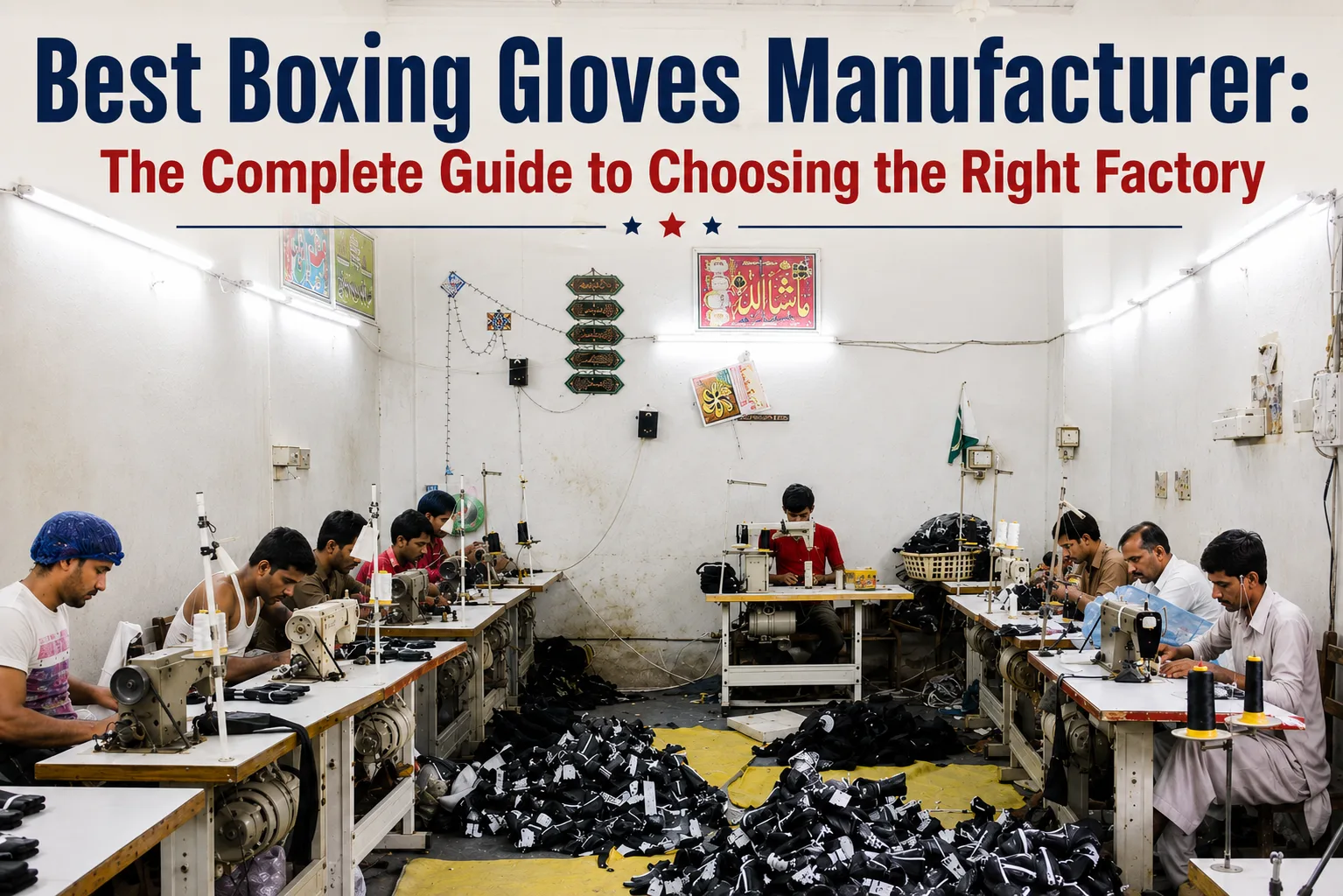
Sialkot, Pakistan, has developed a major sports-goods manufacturing ecosystem and is particularly well known for gloves, footballs, leather goods, and other sporting products.
The city’s advantage is not simply low labor cost.
It is the combination of:
- Experienced craftsmen
- Leather-processing infrastructure
- Sports-goods suppliers
- Cutting and stitching specialists
- Foam and padding suppliers
- Printing and branding services
- Packaging companies
- Export infrastructure
- Generations of manufacturing experience
Current manufacturer pages and industry discussions consistently identify Sialkot as an important production center for boxing and combat-sports equipment.
But buyers should not assume that every Sialkot manufacturer produces the same quality.
This is one of the most important lessons when sourcing from the region.
The manufacturing city matters. The individual factory matters more.
6. How Boxing Gloves Are Manufactured
A quality boxing glove is not simply fabric wrapped around foam.
It is a structured product in which multiple components must work together.
A typical manufacturing process can include:
Step 1: Product specification
The manufacturer receives:
- Design
- Size
- Weight
- Material
- Color
- Logo
- Padding requirements
- Closure specification
- Packaging requirements
Step 2: Pattern development
Patterns determine the dimensions and shape of the glove components.
Poor pattern development can create:
- Incorrect hand positioning
- Poor thumb placement
- Uneven shape
- Excessive pressure points
- Poor wrist support
Step 3: Material cutting
Leather or synthetic material is cut according to the approved pattern.
Step 4: Foam preparation
Padding components are prepared and shaped.
Step 5: Component stitching
Individual panels are stitched together.
Step 6: Palm and thumb construction
The palm and thumb are integrated into the glove structure.
Step 7: Padding insertion
Foam or other padding components are positioned inside the shell.
Step 8: Shell assembly
The outer material and internal components are assembled into the finished glove.
Step 9: Wrist closure
Depending on the design, the glove may use:
- Hook-and-loop closure
- Lace-up closure
- Elastic components
- Other customized fastening systems
Step 10: Finishing
The glove is cleaned, shaped and inspected.
Step 11: Branding
The manufacturer’s approved process may include:
- Screen printing
- Heat transfer
- Embossing
- Debossing
- Patches
- Woven labels
- Printed labels
Step 12: Final quality inspection
The finished gloves are checked against the approved specification.
7. Boxing Glove Materials
The outer shell is one of the most visible differences between boxing gloves.
Common materials include:
Genuine leather
Common options include:
- Cowhide
- Buffalo leather
- Other leather specifications depending on the product
Leather can provide excellent durability and a premium appearance when properly selected and processed.
Synthetic leather
Synthetic materials can provide:
- Consistent appearance
- Easier maintenance
- Competitive pricing
- Good customization flexibility
PU
Polyurethane-based synthetic materials are widely used in sports equipment.
The exact grade and construction matter more than simply calling something “PU.”
Microfiber and advanced synthetic materials
Some manufacturers use modern synthetic materials designed to provide specific combinations of:
- Durability
- Softness
- Flexibility
- Appearance
- Water resistance
- Easy maintenance
The correct material depends on the intended product positioning.
8. Leather vs. Synthetic Boxing Gloves
There is no universal answer that genuine leather is always better.
The correct question is:
Which material is appropriate for the intended application and price point?
Genuine leather may be preferable when:
- Premium positioning is important
- Long-term durability is a priority
- The customer expects natural leather
- The product is positioned as a premium glove
Synthetic leather may be preferable when:
- Price is a major consideration
- High-volume production is required
- Consistency of appearance matters
- Easy cleaning is important
- The product is designed for entry-level or general training use
A good manufacturer should be able to explain the actual material specification instead of simply saying “premium leather.”
9. Understanding Boxing Glove Padding
Padding is arguably one of the most important components of a boxing glove.
Different manufacturers use different foam structures.
Common approaches include:
- Single-density foam
- Multi-layer foam
- Molded foam
- Laminated foam
- Custom foam combinations
A multi-layer construction can allow the manufacturer to tune different characteristics of the glove.
The important factors include:
- Impact absorption
- Shape retention
- Durability
- Density
- Compression
- Weight distribution
- Hand protection
- Partner comfort
A buyer should not evaluate padding only by asking whether the glove contains “high-density foam.”
Ask for the actual construction and intended use.
10. Glove Construction and Stitching
Stitching is another major quality indicator.
Look for:
- Consistent stitch length
- Straight seams
- Quality thread
- Reinforced stress points
- No loose threads
- Proper edge finishing
- Correct panel alignment
- Consistent left/right symmetry
The most expensive leather in the world will not compensate for poor construction.
This is why sample inspection should focus on construction quality, not just appearance.
11. Boxing Glove Weight and Size
Boxing gloves are commonly sold according to weight rather than conventional clothing-style size.
Common weights include:
- 8 oz
- 10 oz
- 12 oz
- 14 oz
- 16 oz
- 18 oz
- Custom weights
The correct weight depends on the application and rules of the relevant organization or gym.
For example, competition requirements can differ from training and sparring requirements.
England Boxing’s 2026 rulebook, for example, specifies particular competition glove requirements by boxer weight category, demonstrating why a manufacturer should not simply describe one glove weight as universally suitable for every competition.
12. Different Types of Boxing Gloves
A professional manufacturer should understand that “boxing gloves” is a broad category.
Important product types include:
- Training gloves
- Sparring gloves
- Bag gloves
- Competition gloves
- Professional boxing gloves
- Amateur boxing gloves
- Muay Thai gloves
- Fitness boxing gloves
- Kids’ boxing gloves
- Custom boxing gloves
Each has different priorities.
13. Training Gloves
Training gloves are designed for general boxing practice.
They may be used for:
- Bag work
- Pads
- General drills
- Technical training
A training glove usually needs a balance of:
- Protection
- Comfort
- Durability
- Versatility
14. Sparring Gloves
Sparring gloves require special attention because another person is being struck.
Important considerations include:
- Padding distribution
- Glove shape
- Thumb construction
- Surface finish
- Weight
- Wrist support
Sparring gloves should be evaluated according to the requirements of the gym, coach, federation or governing organization involved.
15. Bag Gloves
Bag gloves are designed primarily for striking training equipment.
The construction can differ from a sparring glove.
A manufacturer should be able to explain the intended use rather than simply selling the same glove under multiple names.
16. Competition Gloves
Competition gloves are a specialized category.
Competition requirements can be dictated by:
- Boxing organization
- Event
- Weight class
- Amateur/professional rules
- Local regulations
Therefore, a manufacturer should never promise that a glove is “competition approved” without identifying the relevant organization and requirements.
17. Professional Boxing Gloves
Professional gloves may emphasize:
- Premium leather
- Hand-shaped construction
- Specialized padding
- Lace closure
- Premium finishing
- Customized specifications
However, “professional” is frequently used as a marketing term.
Buyers should ask what technically makes the glove professional.
18. Muay Thai Gloves
Muay Thai gloves often have different design priorities compared with conventional boxing gloves.
They may require greater flexibility for:
- Clinching
- Catching
- Blocking
- Hand positioning
An experienced combat-sports manufacturer should understand these differences rather than simply changing the product name.
19. Custom Boxing Gloves
Custom boxing gloves are increasingly important for:
- Boxing brands
- MMA brands
- Gyms
- Training academies
- Distributors
- Retailers
- E-commerce businesses
Customization can include:
Product
- Shape
- Material
- Color
- Weight
- Padding
- Closure
- Thumb
- Wrist
Branding
- Logo
- Brand name
- Embroidery
- Printing
- Embossing
- Labels
Packaging
- Individual boxes
- Polybags
- Custom cartons
- Hangtags
- Inserts
- Retail packaging
A strong manufacturer should be able to convert a buyer’s concept into a repeatable production specification.
20. OEM Boxing Gloves
OEM means the manufacturer produces products according to the customer’s specifications and branding requirements.
For example, a customer may provide:
- Logo
- Colors
- Design
- Materials
- Packaging
- Technical requirements
The manufacturer then produces the gloves accordingly.
OEM is particularly useful for established brands that already have a defined product identity.
21. Private Label Boxing Gloves
Private label manufacturing allows a company to sell boxing gloves under its own brand without owning its own factory.
The manufacturer may provide:
- Product development
- Production
- Branding
- Packaging
- Quality control
- Export support
This model is attractive to:
- Startups
- Amazon/e-commerce brands
- Sports retailers
- Gym chains
- Distributors
- Boxing brands
Private label is one of the strongest opportunities for manufacturers because the buyer is not merely purchasing a commodity. The buyer is building a brand.
22. ODM Boxing Gloves
ODM generally involves adapting or developing a manufacturer’s existing design for the customer’s brand.
This can be faster and less expensive than developing an entirely new glove.
For a startup, ODM can be an efficient way to enter the market.
For an established premium brand, full OEM development may provide more differentiation.
23. Minimum Order Quantity
MOQ is one of the first questions buyers ask.
But MOQ should not be evaluated alone.
A manufacturer might offer:
- 30 pairs
- 50 pairs
- 100 pairs
- 500 pairs
- 1,000+ pairs
The important question is:
What exactly does the MOQ apply to?
For example:
- Per design?
- Per color?
- Per size?
- Per material?
- Per logo?
- Per SKU?
A factory offering a 50-pair MOQ may actually require 50 pairs per color or per design.
Always clarify.
24. Boxing Gloves Manufacturer Pricing
There is no universal “factory price.”
Pricing depends on specifications.
A basic synthetic glove and a premium leather glove can have dramatically different production costs.
Likewise, a 50-pair custom order cannot normally be priced in the same way as a 10,000-pair production run.
The correct approach is to request a specification-based quotation.
25. What Determines the Cost of Boxing Gloves?
Major cost factors include:
Material
Leather generally has different costs from synthetic materials.
Padding
Different foam types and constructions have different costs.
Construction
Complex patterns require more production time.
Branding
Embossing, embroidery, printing and custom labels affect cost.
Packaging
Retail-ready packaging can significantly increase total product cost.
Quantity
Higher quantities generally allow better production economics.
Development
Custom patterns, molds, prototypes and sample development may create additional costs.
Shipping
The product price is only one part of landed cost.
26. A Worked Example: From Factory Price to Landed Cost
Cost factors are easier to evaluate with a real number attached. Here’s an illustrative example – not a quote, just a demonstration of how the pieces stack up:
Suppose a factory quotes $14.00 per pair FOB for a mid-range synthetic training glove, custom logo included, for an order of 500 pairs.
| Cost component | Illustrative amount |
| FOB unit price | $14.00 / pair |
| Freight (sea, per pair, 500-pair order) | ~$1.20 / pair |
| Import duty (varies by destination and product code) | ~$1.50 / pair |
| Customs clearance and inspection | ~$0.40 / pair |
| Estimated landed cost | ~$17.10 / pair |
That’s roughly a 22% increase over the factory price once freight, duty, and clearance are added – before packaging, storage, or your own margin.
This is why comparing manufacturers purely on the FOB quote is misleading. A factory quoting $13.50 FOB isn’t necessarily cheaper once landed cost is calculated, especially if their location, packaging weight, or documentation quality adds friction elsewhere in the chain.
Note: the percentages above are illustrative only – actual freight and duty rates depend heavily on your destination country, product classification, and shipping method. Always request a landed-cost estimate specific to your own order rather than relying on general ranges.
27. Typical Payment Terms When Ordering from a Boxing Glove Manufacturer
Payment terms are one of the questions this guide already tells you to ask (Q20) – here’s what a normal answer typically looks like, so you know what you’re negotiating against.
For samples:
Sample and development costs are usually paid in full, upfront, before work begins. This is standard and not a red flag.
For bulk orders, the most common structure is a split payment:
A deposit – commonly 30% of the order value – paid to confirm the order and begin production.
The balance – the remaining 70% – paid before shipment, once the goods are inspected and ready to leave the factory.
Common payment methods:
T/T (telegraphic transfer / bank wire) – the most common method for small and mid-sized orders. Straightforward, but offers less buyer protection than an LC.
L/C (letter of credit) – more common for larger orders. Provides stronger security for both sides, but adds paperwork and bank fees.
Trade assurance platforms (where sourcing through platforms like Alibaba) – can offer a layer of payment protection for first-time buyers working with an unfamiliar factory.
A few practical notes:
Be cautious of a manufacturer asking for 100% payment upfront on a bulk order – this removes your only real leverage if the finished goods don’t match the approved sample.
For a first order with a new manufacturer, consider requesting a third-party inspection before releasing the balance payment.
Payment terms are usually negotiable, particularly once you’ve placed a few repeat orders and built trust with the factory.
28. Quality Control
A serious manufacturer should have a quality-control system.
Quality inspection can cover:
Incoming materials
- Leather
- Synthetic material
- Foam
- Thread
- Hook-and-loop
- Labels
- Packaging
In-process production
- Cutting
- Stitching
- Padding
- Assembly
- Branding
Finished products
- Weight
- Dimensions
- Appearance
- Stitching
- Symmetry
- Logo placement
- Closure
- Padding
- General workmanship
For private-label buyers, consistency between the approved sample and mass production is particularly important.
29. Sample Development
Never place a large custom order based solely on photographs.
The correct process is generally:
Specification → Sample → Testing → Revision → Approval → Bulk production
A sample should be evaluated for:
- Fit
- Weight
- Shape
- Padding
- Thumb position
- Wrist support
- Stitching
- Material
- Logo
- Color
- Packaging
If changes are required, document them before production.
The approved sample should become the production reference.
30. Certifications and Standards
This is an area where buyers should be especially careful.
Do not simply ask:
“Are your gloves certified?”
Ask:
“Which exact product has been tested, against which standard, by which organization, and can you provide the relevant documentation?”
There is an international standard specifically addressing hand and foot protectors used in unarmed martial arts, including boxing. ISO 21924-7:2017 specifies additional requirements and test methods for such protectors.
At the same time, buyers should understand that there is not one universal certification that automatically makes every boxing glove suitable for every market and every use.
ASTM’s current work item on combative sports gloves notes that there has historically been a need for standardized testing methodology for boxing gloves and headgear.
Therefore, the correct compliance strategy depends on:
- Product
- Intended use
- Destination market
- Customer
- Applicable legislation
- Competition requirements
31. Important Compliance Considerations
If gloves are being sold into the European Union, the buyer and manufacturer should determine whether the specific product falls within applicable PPE requirements.
EU Regulation 2016/425 establishes requirements for PPE placed on the EU market, including manufacturer obligations concerning conformity assessment, technical documentation and, where applicable, CE marking.
This is important because CE marking should never be treated simply as a marketing sticker.
Where CE requirements apply, manufacturers have defined legal obligations.
A responsible manufacturer should therefore be able to discuss:
- Product classification
- Applicable legislation
- Applicable standards
- Test reports
- Technical documentation
- Declaration of Conformity
- CE marking, where applicable
Do not accept vague statements such as:
“All our products are CE certified.”
Ask for the actual documentation.
32. Compliance Standards Specific to Boxing Gloves: EN 13277-1 and CPSIA
Beyond the general ISO and EU PPE requirements already covered, two specific standards are worth asking about directly, depending on your destination market and product line.
EN 13277-1 (European Union). This is the European standard covering protective equipment for martial arts, including requirements relevant to boxing gloves and similar protective gear. If you’re selling into the EU, ask your manufacturer whether their products have been tested against this specific standard – not just against general PPE requirements, but this named one.
CPSIA (United States). The Consumer Product Safety Improvement Act sets mandatory testing and certification requirements for products marketed to children in the US. This is directly relevant if kids’ boxing gloves are part of your product line (see Section 12) and you’re selling into the US market – CPSIA compliance isn’t optional in that case, and a manufacturer should be able to speak to it specifically, not just gesture at “international safety standards.”
As with the broader compliance guidance already in this article: don’t accept a general claim of “we meet all safety standards.” Ask which specific standard, tested by whom, with documentation you can actually review – and confirm it matches both your product category and your destination market, since a standard that applies to adult competition gloves sold in Germany may not be the one that applies to a kids’ training glove sold in the US.
33. How to Audit a Boxing Glove Factory
Before choosing a long-term supplier, evaluate the factory itself.
Ask for:
Factory information
- Factory address
- Production facility photographs
- Production videos
- Number of workers
- Production departments
- Quality-control department
Manufacturing capabilities
- Cutting
- Stitching
- Padding
- Assembly
- Branding
- Packaging
Export experience
Ask:
- Which countries do you export to?
- What types of customers do you serve?
- Can you provide export documentation?
- Do you work with distributors?
- Do you manufacture private-label products?
Quality
Ask for:
- QC procedure
- Inspection checklist
- Material specifications
- Testing documents
A factory visit or independent audit can provide even greater confidence.
34. Questions to Ask a Boxing Gloves Manufacturer
Before placing an order, ask at least these questions:
- Are you a direct manufacturer?
- Where is your factory located?
- What is your MOQ?
- Is MOQ calculated per design or total order?
- What materials do you offer?
- What leather grades are available?
- What foam construction do you use?
- Can you produce custom patterns?
- Can you produce private-label gloves?
- Can you apply our logo?
- Can you make custom packaging?
- What are your sample charges?
- How long does sampling take?
- How long does bulk production take?
- What is your monthly production capacity?
- What quality-control procedures do you follow?
- What markets do you currently export to?
- Can you provide test reports?
- Can you provide compliance documentation where applicable?
- What payment terms do you offer?
- Which Incoterms can you offer?
- How do you handle defective goods?
- What happens if bulk production differs from the approved sample?
- Can you provide production photographs or videos?
- Can you provide references or evidence of export experience?
A manufacturer that answers these questions clearly is usually much easier to evaluate than one that only sends a price list.
35. Red Flags When Choosing a Supplier
Be careful if a supplier:
Refuses to provide basic factory information
Transparency matters.
Gives an unrealistically low price
A very low price can mean:
- Lower-grade material
- Lower foam density
- Reduced labor
- Poor stitching
- Less inspection
- Different specifications
Claims every certification
A supplier claiming that every product is automatically “CE, ISO, FDA, ASTM and approved worldwide” should be examined carefully.
Cannot explain the product
If the salesperson cannot explain the material, foam, construction and intended use, consider whether they actually manufacture the product.
Changes specifications without approval
This is a serious problem for private-label brands.
Avoids samples
A professional manufacturer should understand why samples are important.
Cannot maintain consistency
The first order may look excellent, but repeat production may differ.
Consistency is one of the most important characteristics of a good manufacturer.
36. How to Compare Five Manufacturers
Do not compare manufacturers based only on price.
Create a supplier scorecard.
| Factor | Weight |
| Product Quality | 25% |
| Manufacturing Capability | 15% |
| QC System | 15% |
| Customization | 10% |
| Price | 10% |
| MOQ Flexibility | 5% |
| Lead Time | 5% |
| Communication | 5% |
| Compliance Documentation | 5% |
| Export Experience | 5% |
Score each manufacturer from 1 to 10.
Then calculate the weighted score.
This approach prevents a supplier from winning simply because it quoted $1 less per pair.
37. Best Manufacturer for Startups
Startups normally need:
- Low MOQ
- Competitive pricing
- Custom branding
- Sample support
- Design assistance
- Flexible packaging
- Reasonable payment terms
A startup should generally avoid selecting a factory purely because it has enormous production capacity.
A smaller or medium-sized manufacturer may provide better attention during the development stage.
38. Best Manufacturer for Established Brands
Established brands typically prioritize:
- Consistency
- Production capacity
- Technical development
- Quality systems
- Compliance
- Supply reliability
- IP protection
- Long-term pricing
For these buyers, factory systems become more important than simply finding the lowest unit price.
39. Best Manufacturer for Gyms and Academies
Gyms normally need:
- Durable products
- Consistent sizing
- Good value
- Replacement availability
- Custom logos
- Smaller quantities
A manufacturer offering custom gym branding and reasonable MOQ can be particularly valuable.
40. Best Manufacturer for Distributors
Distributors need:
- Consistent pricing
- Repeatable quality
- Reliable production
- Large-volume capability
- Packaging options
- Export documentation
- Stable lead times
The distributor’s biggest risk is usually not paying slightly more.
It is receiving inconsistent products that create returns and customer complaints.
41. Best Manufacturer for Premium Boxing Gloves
Premium buyers should evaluate:
- Leather quality
- Leather thickness
- Construction
- Padding architecture
- Hand compartment
- Stitching
- Finishing
- Symmetry
- Product development
A premium glove should feel premium before the logo is even added.
42. Best Country for Boxing Glove Manufacturing
The answer depends on your business model.
Pakistan
Particularly strong for:
- Leather sports goods
- Boxing equipment
- Combat sports equipment
- Handcrafted construction
- OEM
- Private label
- Competitive manufacturing
Sialkot’s established sports-goods ecosystem is a major advantage.
China
Often attractive for:
- Large production runs
- Broad manufacturing ecosystems
- Product variety
- Integrated supply chains
Thailand
Strong association with:
- Muay Thai equipment
- Combat sports culture
- Specialized fight equipment
Japan
Known for specialized craftsmanship and premium products.
Mexico
Has a strong boxing culture and established boxing-equipment manufacturing sector.
The best choice depends on the product rather than the country alone.
43. How to Order Custom Boxing Gloves
A professional custom order should follow a defined process.
Step 1: Define the product
Specify:
- Glove type
- Weight
- Material
- Color
- Padding
- Closure
- Thumb
- Stitching
- Logo
Step 2: Provide branding
Supply:
- Vector logo
- Brand guidelines
- Pantone references where relevant
- Packaging artwork
Step 3: Approve quotation
Confirm:
- Unit price
- MOQ
- Tooling/sample charges
- Packaging
- Shipping terms
Step 4: Develop sample
The factory produces the prototype.
Step 5: Test sample
Check:
- Fit
- Comfort
- Weight
- Shape
- Construction
- Logo
- Packaging
Step 6: Revise
Document every required modification.
Step 7: Approve final sample
The approved sample becomes the reference.
Step 8: Start production
The factory produces according to the approved specification.
Step 9: Inspect
Perform pre-shipment inspection where appropriate.
Step 10: Ship
Use the agreed Incoterm and documentation.
44. Packaging and Branding
A private-label manufacturer should ideally support more than simply adding a logo.
Branding opportunities include:
- Glove logo
- Wrist logo
- Embossed logo
- Woven label
- Hangtag
- Care label
- Barcode
- Size label
- Individual packaging
- Retail box
- Master carton
- Instruction card
For e-commerce brands, packaging is particularly important because the customer experiences the product before they ever use it.
45. International Shipping
The manufacturer’s responsibility does not necessarily end when production finishes.
International B2B orders can involve:
- Commercial invoice
- Packing list
- Certificate of origin
- Export declaration
- Shipping documents
- Freight booking
- Customs information
The buyer should agree in advance on:
- EXW
- FOB
- CFR
- CIF
- DAP
- DDP
depending on the transaction.
Never assume shipping is included in a factory price.
46. Lead Times
Lead time depends on:
- Quantity
- Product complexity
- Material availability
- Custom branding
- Packaging
- Sampling
- Production schedule
- Season
- Shipping method
Ask for separate timelines for:
Sampling
and
Bulk production
A supplier saying “20 days delivery” without explaining whether that means production or production plus shipping is not providing enough information.
47. How to Protect Your Brand
When developing custom boxing gloves, your design may represent significant commercial value.
Protect:
- Logos
- Artwork
- Product designs
- Technical specifications
- Packaging
- Brand identity
Use written specifications and approval records.
If the design is commercially important, consider appropriate contractual protections concerning:
- Confidentiality
- Intellectual property
- Exclusivity
- Tooling ownership
- Design ownership
The exact legal protections should be reviewed according to the countries involved.
48. Why Cheap Boxing Gloves Can Become Expensive
Suppose one supplier offers:
$15 per pair
and another offers:
$19 per pair.
The first quotation looks better.
But imagine the $15 glove produces:
- 5% defect rate
- More customer returns
- Shorter product life
- Poor reviews
- Inconsistent repeat orders
The $19 glove might ultimately be much cheaper for the business.
This is why professional buyers calculate total cost of ownership, not merely purchase price.
Consider:
Product cost + shipping + inspection + defects + returns + customer service + reputation
That is your real cost.
49. The Ideal Boxing Gloves Manufacturer Checklist
Before selecting your manufacturer, confirm:
Factory
- Direct manufacturer verified
- Factory location confirmed
- Production capabilities verified
- Export experience confirmed
Product
- Material specified
- Padding specified
- Weight specified
- Closure specified
- Design approved
- Size specification approved
Quality
- Sample inspected
- Sample approved
- QC process defined
- Defect policy agreed
- Bulk production matched to approved sample
Branding
- Logo approved
- Labels approved
- Packaging approved
- Artwork confirmed
Commercial
- MOQ confirmed
- Unit price confirmed
- Sample cost confirmed
- Payment terms confirmed
- Production lead time confirmed
- Shipping terms confirmed
Compliance
- Destination-market requirements reviewed
- Relevant test reports requested
- Relevant declarations/documentation requested
- Certification claims verified
50. Frequently Asked Questions
Who is the best boxing gloves manufacturer?
There is no single manufacturer that is best for every buyer.
The best manufacturer is the factory that can consistently meet your required quality, specifications, MOQ, price, customization, compliance and delivery requirements.
For many international B2B buyers, Sialkot, Pakistan is an important sourcing location because of its established sports-goods manufacturing ecosystem.
What is the best country for boxing glove manufacturing?
Pakistan, China, Thailand, Japan and Mexico are among the important manufacturing locations buyers may consider.
The best country depends on the product specification, quantity, budget, customization requirements and target market.
Is Sialkot good for boxing gloves?
Yes. Sialkot has a long-established sports-goods manufacturing ecosystem and numerous factories producing boxing and combat-sports equipment.
However, buyers should evaluate individual factories rather than assuming every manufacturer produces the same quality.
What is the best material for boxing gloves?
Genuine leather can be an excellent choice for premium gloves, while high-quality synthetic materials can provide strong performance at competitive prices.
The best material depends on intended use, budget, durability requirements and product positioning.
How much do boxing gloves cost from a manufacturer?
There is no standard factory price.
Cost depends on:
- Material
- Padding
- Weight
- Construction
- Branding
- Packaging
- Quantity
- Customization
- Shipping terms
The best way to compare prices is to provide identical specifications to multiple manufacturers.
What MOQ should I expect?
MOQ can range from relatively small development orders to thousands of pairs.
The key is to determine whether the MOQ applies to the entire order, design, color, size or SKU.
Can I put my own logo on boxing gloves?
Yes. Many OEM and private-label manufacturers offer custom branding.
Common methods include:
- Printing
- Embossing
- Debossing
- Patches
- Labels
- Custom packaging
Can a manufacturer make completely custom boxing gloves?
Yes, experienced OEM manufacturers can develop custom gloves from technical specifications, drawings, reference samples or approved prototypes.
The complexity and cost depend on how different the design is from an existing factory pattern.
Should I order samples before bulk production?
Absolutely.
A sample is one of the most important quality-control tools available to a B2B buyer.
Never approve a large custom order based solely on photographs.
How long does boxing glove production take?
Production time varies according to quantity, design complexity, material availability, branding and factory workload.
Always ask the manufacturer for a specific production schedule for your order rather than relying on a generic lead-time statement.
What certifications should boxing gloves have?
That depends on the product and destination market.
ISO 21924-7:2017 is an international standard covering additional requirements and test methods for hand and foot protectors used in unarmed martial arts, including boxing.
For products falling within EU PPE requirements, Regulation (EU) 2016/425 establishes conformity obligations, technical documentation requirements and CE-marking rules where applicable.
Always verify the exact requirements applicable to your product and market.
What is the difference between OEM and private label?
OEM generally means producing according to the customer’s specific product requirements.
Private label means manufacturing a product that is sold under the buyer’s brand.
The two models frequently overlap.
What is ODM?
ODM usually involves adapting or developing an existing manufacturer design for a customer’s brand.
It can be faster and less expensive than developing a completely new product.
How do I verify that a supplier is a real manufacturer?
Ask for:
- Factory address
- Factory video
- Production photographs
- Manufacturing process
- Employee/production information
- Sample development capability
- Export records
- Quality-control process
Where possible, conduct a factory visit or independent audit.
51. Final Verdict: How to Find the Best Boxing Gloves Manufacturer
The phrase “best boxing gloves manufacturer” sounds like it should have one simple answer.
It doesn’t.
The best manufacturer is not necessarily the cheapest factory.
It is not necessarily the largest factory.
It is not necessarily the company with the best website.
And it is not necessarily the manufacturer with the longest list of certifications.
The best manufacturer is the one that can consistently deliver the right product, at the right quality, at the right price, in the right quantity, with the right documentation, on the right schedule.
For a serious B2B buyer, the decision should therefore be based on:
Product quality + manufacturing capability + customization + consistency + QC + compliance + communication + price + delivery.
If you are building a boxing brand, the manufacturer’s role becomes even more important.
Your customers will never see your purchase order.
They will see your gloves.
They will feel the padding.
They will notice the stitching.
They will judge the fit.
They will test the durability.
They will decide whether your product deserves another purchase.
That means your manufacturer is effectively part of your brand.
The smartest way to choose
Do not ask five factories:
“What is your best price?”
Instead, send all five manufacturers the same detailed product specification and ask them to quote exactly the same product.
Then compare:
- Sample quality
- Materials
- Padding
- Construction
- QC
- MOQ
- Price
- Lead time
- Customization
- Compliance
- Communication
- Export experience
The manufacturer that wins across these categories is far more likely to be the right long-term partner than the supplier that simply offers the lowest quotation.
Looking for a Custom Boxing Gloves Manufacturer?
For brands, distributors, gyms and retailers that need OEM or private-label boxing gloves, the best starting point is to prepare a clear product specification before requesting quotations.
Include:
- Glove type
- Weight
- Material
- Padding preference
- Colors
- Logo
- Closure
- Quantity
- Packaging
- Destination country
- Target price
- Required certifications or standards
A professional manufacturer can then evaluate the project properly instead of giving you a generic catalogue price.
For manufacturers such as Parana Sports Industries, the opportunity is particularly relevant when buyers need more than ready-made gloves and are looking for a long-term OEM/private-label manufacturing relationship covering boxing gloves and broader combat-sports equipment.
The strongest supplier relationship is not the one that produces your first order.
It is the one that can produce your 100th order to the same approved specification as your first.
That is the real standard for choosing the best boxing gloves manufacturer.